Environmental Economics (Eco 345)
Environmental Economics (Eco 345)
FINAL REVIEW SOLUTIONS ARE UP. SEE BELOW.

Course Description
Environmental economics is the study of how the economy affects the environment (the recession has caused a dip in
greenhouse gas emissions), how the environment affects the economy (tempertaure increases adversely affects the skiing
industry), and the appropriate way to regulate economic activity so as to achieve an optimal balance between competing
environmental and economic goals (which is the best way to regulate carbon emissions, a cap-and-trade plan or an
emissions tax?).
General Information
Professor: Associate Professor Dr. David L. Kelly (Dave).
Course Meetings:
Monday and Wednesdays from 2:05 to 3:20 pm in SB 402.
Office: Room 521B, Jenkins School of Business.
Office hours: Tuesdays at 2-3 pm (Dave is almost always around during business hours, but try to come
during office hours if you can).
Contacts: Dave can be contacted via phone (8x3725) or email (dkelly@miami.edu).
Web Site:
Dave has established a website (http://moya.bus.miami.edu/~dkelly/teach/eco345/index.html)
for this course. At this site, you can download or view course material (homeworks, etc.), as well as a continuously
updated syllabus.
Final Exam:
Wednesday, December 14 from 2 pm to 4:30 pm (Section G).
Prerequisites
This course requires Eco 211 (Principles of microeconomics) and Eco 302 (Intermediate microeconomics is strongly suggested).
Textbooks
The required textbook is:
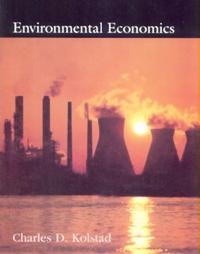
Charles D. Kolstad, Environmental Economics Oxford University Press, 2011.
Grades
3 Homeworks (September 14, October 19, and November 16) 25%
First Challenge (Quiz): Wednesday October 5, 25%
Second Challenge (Quiz): Wednesday November 2, 25%
Final Challenge (Quiz): Wednesday December 14, 25%
You can now access your grades on line HERE!
Additional Notes
- Attendance is very important for this class. All exam material comes from class notes, and not all class notes
are available in the book. Dave tries to reference every topic (whether in the book or elsewhere). However, the wily
student usually aces the course by attending every class and taking careful notes.
- The two quizzes are Wednesday October 5 and Wednesday November 2. Now is the time to mark your calendars.
Only in the most dire emergencies can the student not take a quiz at the scheduled time. Even in dire emergencies,
Dave does not allow a make-up, but instead counts the final double. STUDENTS MUST LET DAVE KNOW OF THEIR DIRE EMERGENCY
BEFORE THE QUIZ BEGINS OR ELSE A ZERO IS AUTOMATICALLY RECORDED.
- Homeworks are due in class, at the beginning of class. Showing up 20 minutes late because you didn't finish the
homework on time is not acceptable. Putting a homework in my mailbox, under my door, etc. is also not acceptable.
Emailing homework is only acceptable if done in advance. By emailing my the homework right before class, you run the
risk that I will examine the homework after class and be unable to open the file, in which case a zero is automatically
recorded. Only in the most dire emergencies can a student be excused from turning in a homework on time. Even in dire
emergencies Dave does not allow the homework to be turned in late, but will instead weight the final more. Students must
let Dave know of their dire emergency before the beginning of the class for which the homework is due or else a zero is
automatically recorded.
- Computers are not allowed in class. 99% of what you need to write down is either math or graphs. Most definitions,
etc. are in the notes Dave provides.
- Smart phones, texting, portable games, X-boxes, Wiis, etc. are not allowed. Seeing students text breaks Dave's
mental flow. Therefore, each time Dave sees a student texting, he will subtract 1% from that students final grade.
WARNING: Dave can see you text even when done in the back of the class or under the table.<\LI>
Course Outline
- Introduction (August 24 - 31).
- What is Environmental Economics? (1.1).
- Topics (1.6)
- Approach
- Positive versus Normative (2).
- Moral neutrality and market failure. (3.1)
- Resource Economics, ecological economics (1.1).
- The economy and the environment: stylized facts (1.2).
- Environmental Regulation (1.3,1.4).
- Social choice, markets, and market failure (August 31 - September 28).
- Social Choice.
- Utility (3.3).
- Pareto criterion (3.3).
- Markets
- Pareto efficiency (4.1).
- Edgeworth Box (4.2).
- Welfare theorems (4.2)
- HOMEWORK 1, DUE SEPTEMBER 14
- Surplus (4.3)
- Market failure.
- Public Goods (5.3-5.5).
- Externalities (5.2).
- Regulation under certainty (October 3 - October 24).
- Property rights (13.1).
- Coase theorem.
- Polluter pays principle.
- FIRST QUIZ OCTOBER 5
- Market based regulation.
- Pigouvian Taxes (12.1-12.4).
- HOMEWORK 2, DUE OCTOBER 19
- Tradeable permits (11.3,13.2).
- Liability (11.3).
- Command and control (11.3).
- Regulation under uncertainty and other issues (October 24 - November 14).
- Taxes versus permits (15).
- Taxes versus permits under uncertainty
- SECOND QUIZ, NOVEMBER 2
- Safety valves and other hybrids (15.2b)
- Optimal monitoring (16.2).
- Initial permit allocation (13.2).
- HOMEWORK 3, DUE NOVEMBER 16
- Double dividend (12.5).
- National and International trade and the environment (November 16-30).
- Environmental Kuznets curve (20.1-20.2).
- Pollution Havens (19.1).
- Transboundry pollution (19.1).
- Climate change (articles).
Class Handouts
Note: all handouts may be downloaded as Adobe Acrobat pdf files. If your computer cannot read acrobat files, download
the reader for free HERE .
Homework 1, Due Wednesday, September 14.
Homework 1, Solutions.
Review, First Quiz.
First Quiz.
First Quiz, Solutions.
Homework 2, Due October 19.
Homework 2, Solutions.
Review, Second Quiz.
Second Quiz.
Second Quiz, Solutions.
Homework 3, Due November 16.
Homework 3, solutions.
Final Review
Final Review Solutions
Notes, graphs, tables, etc.
Below are some notes for the class. I will add notes periodically throughout the semester. You will see that these
notes, while helpful, are in an outline format and do not substitute for the notes taken in class.
Notes: Introduction (Section I)
Notes: Markets and Market Failures (Section II-III)
Notes: Regulation Under Certainty (Section IV)
Notes: Uncertainty and other issues. (Section V)
Notes: Trade (Section VII)
Up to Dave Kelly's homepage
Careers in Economics